
“What Makes a Good Leader” According to the Harvard Business Review


Reading time: 5 minutes
As I dove deeper into the subject of leadership, I found an insightful revelation: technical skill and intelligence alone aren’t what make great leaders. The subject of Emotional intelligence (EI) kept coming up and seemingly plays a far more significant role. In my research on leadership, I came across an insightful Harvard Business Review article on the building blocks of effective leaders at all levels of an organisation. It was a very comprehensive deep dive into the different aspects that were almost universally present in all those who held leadership positions and were held in high regard in said positions. Surprisingly, success in these positions had a low correlation with general skill and intelligence necessary for their jobs; in fact there were many people who were highly intelligent and capable on paper who were failing in their roles. He also highlights that people with comparatively “average” ability in this regard often excel. The author then goes on to explain a key difference in their performances is due to EI.
Analysing 188 large companies who mostly had operations on a global scale, Goleman (the author) used a competency model to analyse certain capabilities grouped into technical skills, cognitive abilities, and competencies demonstrating emotional intelligence. He found that EI was almost twice as important as any other skill that he measured during his analysis and it accounted for nearly 90% of the difference between star performers and average performers. Goleman breaks up EI into 5 major components, which are all important in order to display high emotional intelligence and therefore excel as leader:
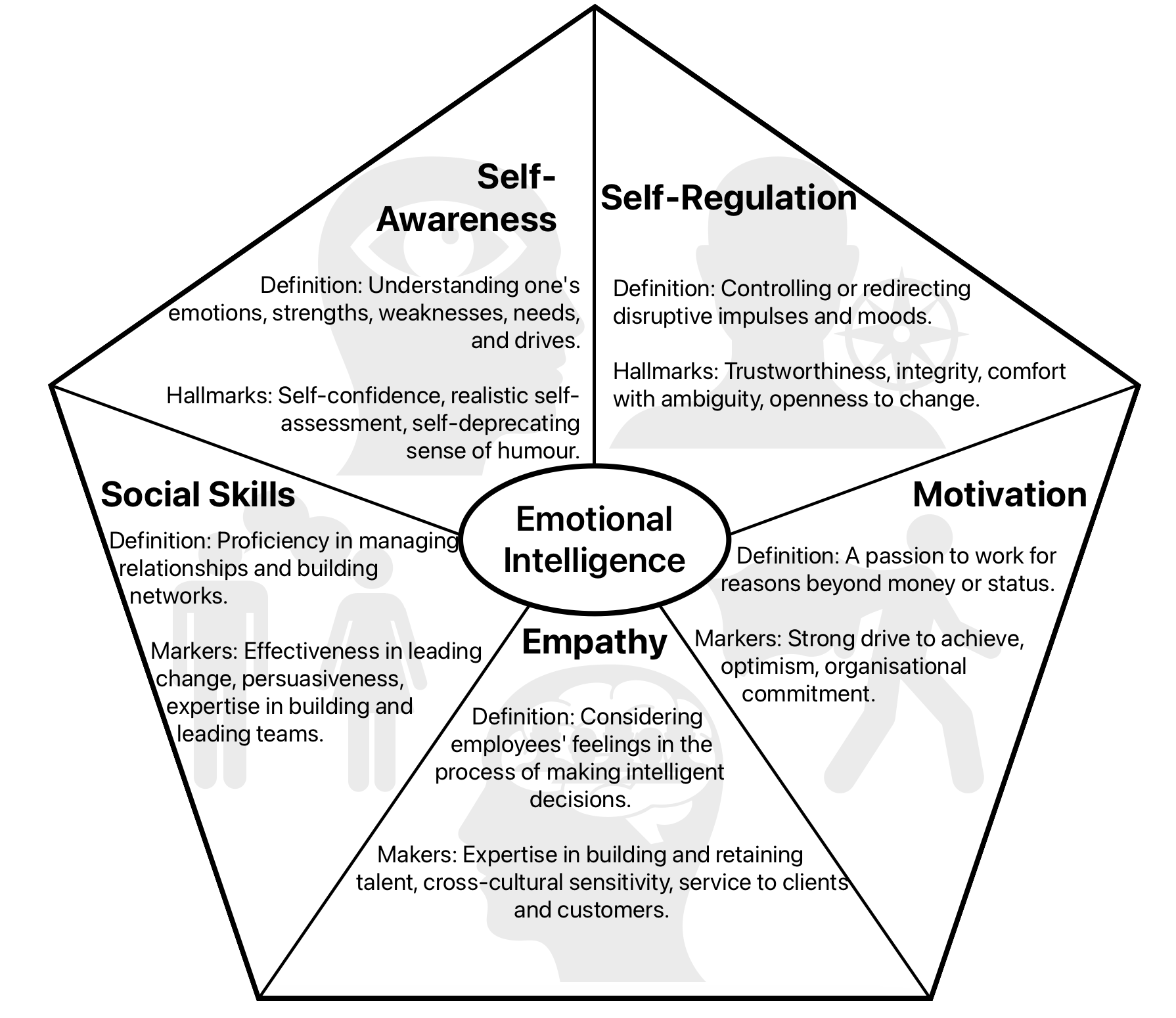
Now, while this visualisation is certainly wonderful I think it would be prudent to explain these components in further detail. The author uses a case study for each of the five proving a real life example of where these skills come into action.
Self-Awareness
Often seen as not being either overly critical nor having impractical levels of optimism (realistic self-assessment) when considering their own actions, they also recognise how their own emotional state affects those around them. An example used for this was with a large department store manager. The manager was feeling upset because the company rolled out a new personal-shopper service and she wanted to lead the rollout but was not selected unfortunately. She opened up to her team and superiors that she was displeased with not being selected, telling them to give her some time while she deals with it. After taking some time to reflect and process her feelings, she managed to get over her disappointment and fully support the project a week later. This shows how self-awareness helps leaders be real and honest, addressing any personal issues upfront.
Self-regulation
In this case study executives for a food company would often withhold certain details with food distributors in order to have a better position negotiating which then led to more money. However one executive believed that being completely transparent and always sharing the cost structure openly would be best for everyone involved. Though he sometimes felt tempted to withhold information to achieve short-term gains, he often reminded himself of the value of honesty and how important it is to building long-term relationships. In the end, his honest approach paid off, as he built strong connections with distributors, benefiting the company far more in the long run than any quick profit ever could have. This demonstrates how self-regulation, along with integrity, can create positive long term business outcomes.
Motivation
In this case intrinsic motivation. In one case study a cosmetics company manager was displeased with the amount of time it took for sales data to provided for him. He proactively set up an automated phone system that allowed salespeople to report their daily figures, reducing the feedback time from weeks to hours. In another case, a portfolio manager faced three consecutive quarters of losses, losing large clients in the process. Rather than blaming external factors, she saw it as a chance to prove her ability to turn things around. By analysing the situation and amending her approach, she bounced back and was promoted within two years. Upon reflection, she said it was "the best thing that ever happened" to her because of the lessons she learned. This highlights how motivation and self-regulation can help leaders overcome setbacks and use them as opportunities to grow.
Empathy
In my opinion one of the most crucial elements of EI. It is vital to things like job satisfaction, retention, motivation levels, and other aspects I have discussed in previous articles (which you should check out). In one case study used by the author: after a brokerage company merger led to redundant jobs, one manager gave a negative speech (talking around the difficulties ahead), while another openly addressed employees' fears and promised fair treatment, which helped retain talent and keep productivity high. Sometimes a simple acknowledgment of ones’ emotions is enough to make a difference. In another case, a marketing manager at an IT company dealt with an overloaded, struggling team by having one-on-one sessions and encouraging open communication. This approach improved collaboration and led to more business from internal clients. Both cases show that empathetic leaders foster stronger team cohesion and better business outcomes internally and externally.
Social Skills
Much to the introvert’s chagrin, it is necessary in management for daily operations. Some may say pleasantries are a waste of time, but they build relationships that lead to more effective and productive connections in the long run. A case study was done observing a global computer manufacturer executive, convinced that the company's future was tied to the Internet (note that this was published in 1998). He took action by creating a virtual community that spanned different levels and divisions, launched a corporate website, and got the company involved in key conventions. His efforts led to the creation of the company's first Internet division, with him at the helm. This case shows leaders to effectively use their emotional intelligence foster environments that facilitate social skills which can lead to innovation and growth in ways previously not foreseen.
In conclusion, in today’s constantly changing world of leadership and management, EI is not just a buzzword but an essential skill to drive real measurable results for your coworkers and clients alike. Whether it’s through self-awareness, self-regulation, motivation, empathy, or social skills, the case studies show how these abilities shape successful leaders; those who master these skills will not only improve team dynamics but also foster long term success for their organisations both internally and externally. As these examples illustrate, leadership isn’t just about being smart or technically able but about practising emotional intelligence in every interaction, shaping more effective teams and fostering long term success.
Reference:
Goleman, D. (1998) ‘What Makes A Leader’, Harvard Business Review, pp. 92–102. Available at: https://media.truelocal.com.au/1/1/125B03BC-9911-470A-97C9-9068679D7361/1348966626658_3WhatMakesALeader.pdf.